Why flying a wounded person was an unusual idea
World War I put immense pressure on ground transport. Moving a wounded person from a battlefield to a place of care could involve stretcher bearers, horse-drawn vehicles, motor ambulances and trains. Each stage depended on routes that might be crowded, damaged or exposed to fighting. Aircraft offered a striking possibility: they could cross difficult ground without following a road. But the ability to fly over an obstacle did not mean a patient could easily be brought aboard or delivered to a hospital.
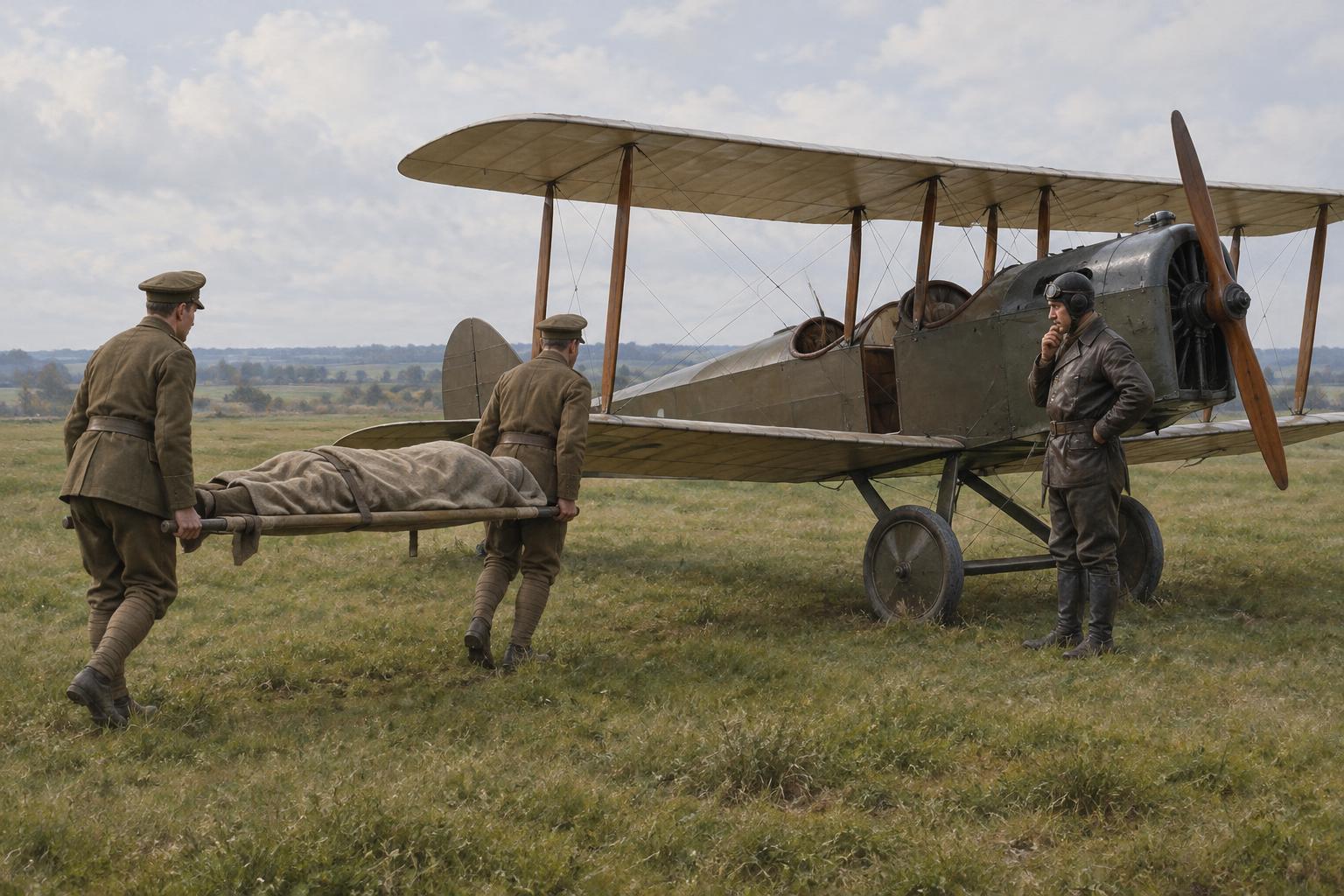
Military aircraft of the period were designed chiefly for observation, fighting and other wartime tasks, not for carrying patients. Many had small cockpits, limited payload capacity and little protection from noise, cold or vibration. Even where an aircraft could take a passenger, a seriously wounded person might need to lie flat and be handled with care. Early air evacuation was therefore an experiment in fitting a human need into machines built for another purpose.
From improvised rides to an evacuation concept
Accounts of wartime air evacuation include isolated flights and proposals to adapt aircraft for carrying casualties. Such examples matter, but they should not be mistaken for evidence of a widespread, routine service. Circumstances varied: an available aircraft, a usable landing area and the condition of the wounded person could all determine whether a flight was possible. Records of individual attempts also do not always support a simple answer to who was “first.”
The larger idea was more ambitious than giving a wounded person a ride. An evacuation aircraft would need a way to load someone who could not climb into a cockpit, space to position that person securely and a destination able to receive them. It would also need to fit into a chain of transport before and after the flight. World War I brought these requirements into focus, even though the aircraft and organization of the time often fell short of them.
The practical barriers on the ground and in the air
A flight could begin only if the patient reached a suitable landing area. That might require a difficult ground journey—the very problem the aircraft was meant to ease. Once there, crew members faced the challenge of lifting a person into a narrow airframe without worsening an injury. Loading a stretcher was especially hard when cockpit openings, structural supports or control cables occupied the available space.
Flying introduced another set of limits. Early aircraft were sensitive to weather and often lacked the range or reliability needed for a predictable transport schedule. A patient exposed to wind and cold could have a very different journey from a seated, healthy passenger. Space for an attendant was limited or nonexistent in many designs, so observation and assistance during flight could be minimal. At the destination, someone still had to unload the patient and arrange onward care.
What these attempts taught aircraft designers
The difficulties pointed toward a distinction that remains useful in aviation history: carrying a casualty is not the same as designing an aircraft for casualty transport. A more suitable layout would make room for a stretcher, provide an accessible opening and allow the patient to be secured. Designers would also have to balance those features against weight, aircraft performance and the space needed by the crew.
No single World War I experiment solved every part of that problem. The value of the early attempts lay partly in making the constraints visible. They showed why an aircraft’s speed alone was not enough to judge its usefulness. Ground access, loading, conditions in flight and the handoff at arrival all affected whether flying could improve the patient’s journey.
A beginning, not a modern service
It is tempting to look back at these flights as miniature versions of modern air ambulance operations. That comparison can obscure how improvised they were. Early wartime efforts did not generally have the purpose-built cabins, equipment, communications or coordinated transport arrangements associated with later services. They took place amid competing military demands for aircraft and crews.
Their historical importance is clearer when viewed as a beginning in problem-solving. World War I demonstrated that a wounded person could sometimes be moved by air, while exposing the many conditions required to make that option useful. Later advances in aircraft design and transport organization would build on those lessons. The central question remained the same: not simply whether an aircraft could make the flight, but whether the entire journey could work for the person being carried.