The appeal of crossing distance by air
Long-distance patient transport presents a problem that ordinary travel does not: the journey must account for the patient’s condition as well as the route. Roads may be slow, indirect or unavailable, while a suitable destination may be far from where a patient begins. As aircraft became more capable, carrying patients by air offered a way to reduce some of those geographic barriers.
Early aeromedical flights were not simply modern air ambulances with older engines. Aircraft had limited cabin space, and keeping a patient accessible during flight could be difficult. Weather, landing sites, noise and vibration also constrained what crews could do. The value of flight was clear in some circumstances, but turning an aircraft into a reliable transport environment required changes well beyond finding room for a stretcher.
From occasional flights to a planned transport role
Military and civilian users both helped establish the idea that patients could be moved over substantial distances by air. Experience with evacuation showed that flight could connect remote locations, intermediate stops and larger centers. It also exposed a recurring challenge: the patient’s journey did not start at takeoff or end at landing. Ground vehicles, receiving facilities and flight crews had to fit into the same plan.
Over time, improved aircraft range and more dependable aviation infrastructure made longer transfers more practical. Airports, navigation systems and communications gave planners more options than an isolated flight could provide. Fixed-wing aircraft were particularly suited to routes between airfields, where they could cover considerable distances efficiently. That strength came with a limitation: patients usually still needed ground transport between the airport and each facility.
Making the cabin work for patient transport
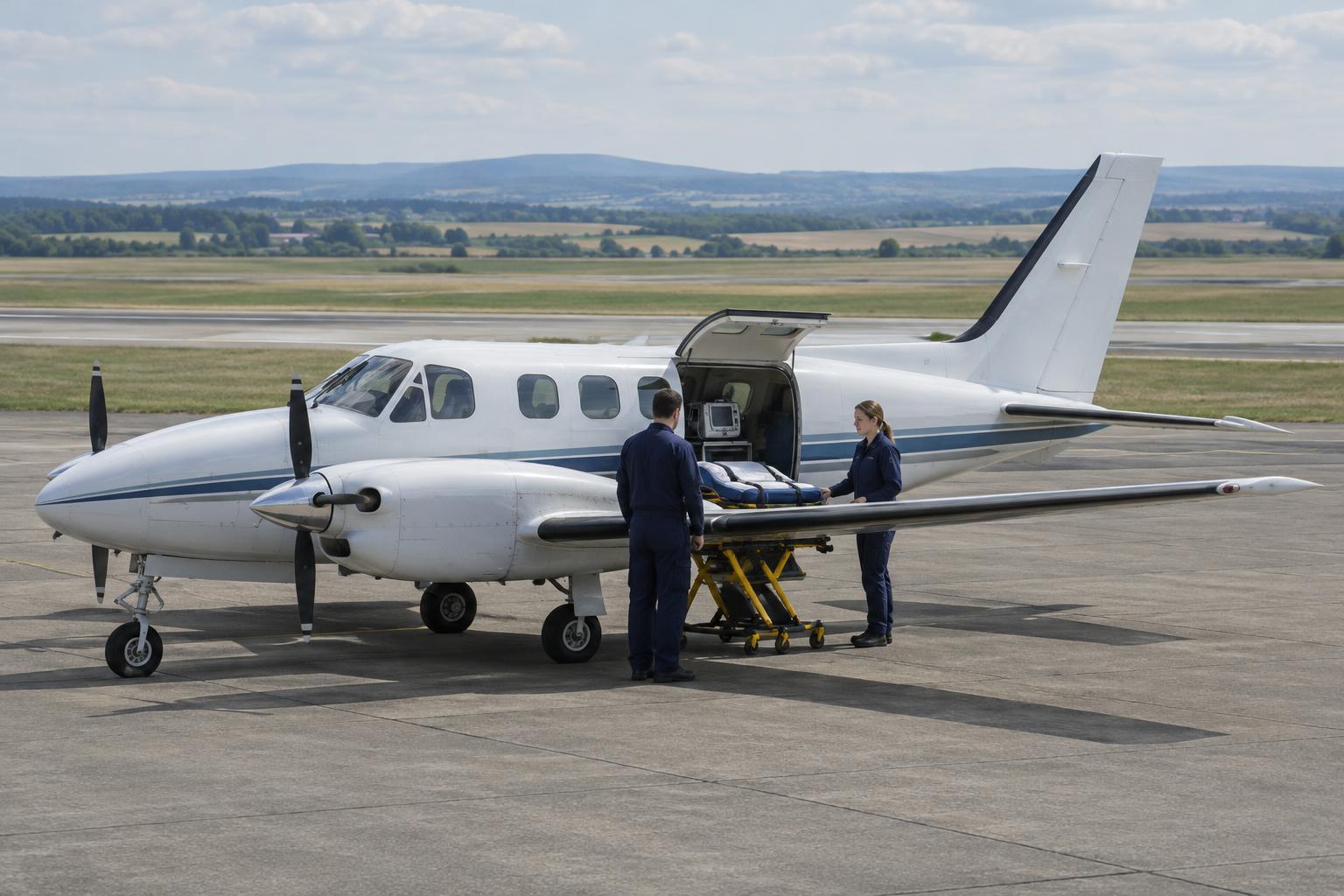
A passenger aircraft is designed around seated travelers. A patient transport cabin has different priorities. It needs a secure place for a stretcher, room for attendants to reach the patient, and space for equipment and supplies. The layout must also respect the aircraft’s weight and balance limits and keep equipment restrained during taxi, takeoff, turbulence and landing.
Developments in smaller multiengine and turbine-powered aircraft expanded the range of possible transport configurations. Pressurized cabins, where available, made higher-altitude flight more manageable for occupants, although altitude and cabin conditions still had to be considered when planning a trip. Electrical power, lighting and accessible storage became important design considerations as onboard equipment grew more capable. No single aircraft solved every transport problem; the useful configuration depended on distance, airports, cabin dimensions and the needs of the particular journey.
Why coordination became as important as speed
The history of fixed-wing air ambulance transport is also a history of handoffs. A sending facility prepares the patient for departure; a ground team brings the patient to an airport; the flight team conducts the airborne portion; and another ground team completes the trip. Each transfer calls for clear information about timing, equipment and who is responsible for the next step.
Planning a flight involves more than comparing air and road travel times. Crews must consider airport access, weather, fuel stops, aircraft suitability and the time spent moving between facilities and airfields. Clinical personnel and aviation personnel have distinct responsibilities, so effective communication helps them identify constraints before departure rather than discovering them at the aircraft door. A faster flight is not necessarily a simpler overall journey.
A distinct place in the transport network
Fixed-wing air ambulances became useful because they addressed a particular kind of distance problem. They can link communities and facilities separated by long routes, including journeys for which a lengthy ground transfer would be difficult to arrange. Their role differs from that of helicopters, which may be able to use landing areas closer to a scene or facility but generally serve different distance and access needs.
Looking back, the lasting change was not one invention or aircraft model. It was the gradual combination of suitable cabins, aviation infrastructure, onboard equipment and coordinated teams. Fixed-wing patient transport works as part of a wider network, with its benefits and limitations shaped by the entire route—not just the time spent in the air.