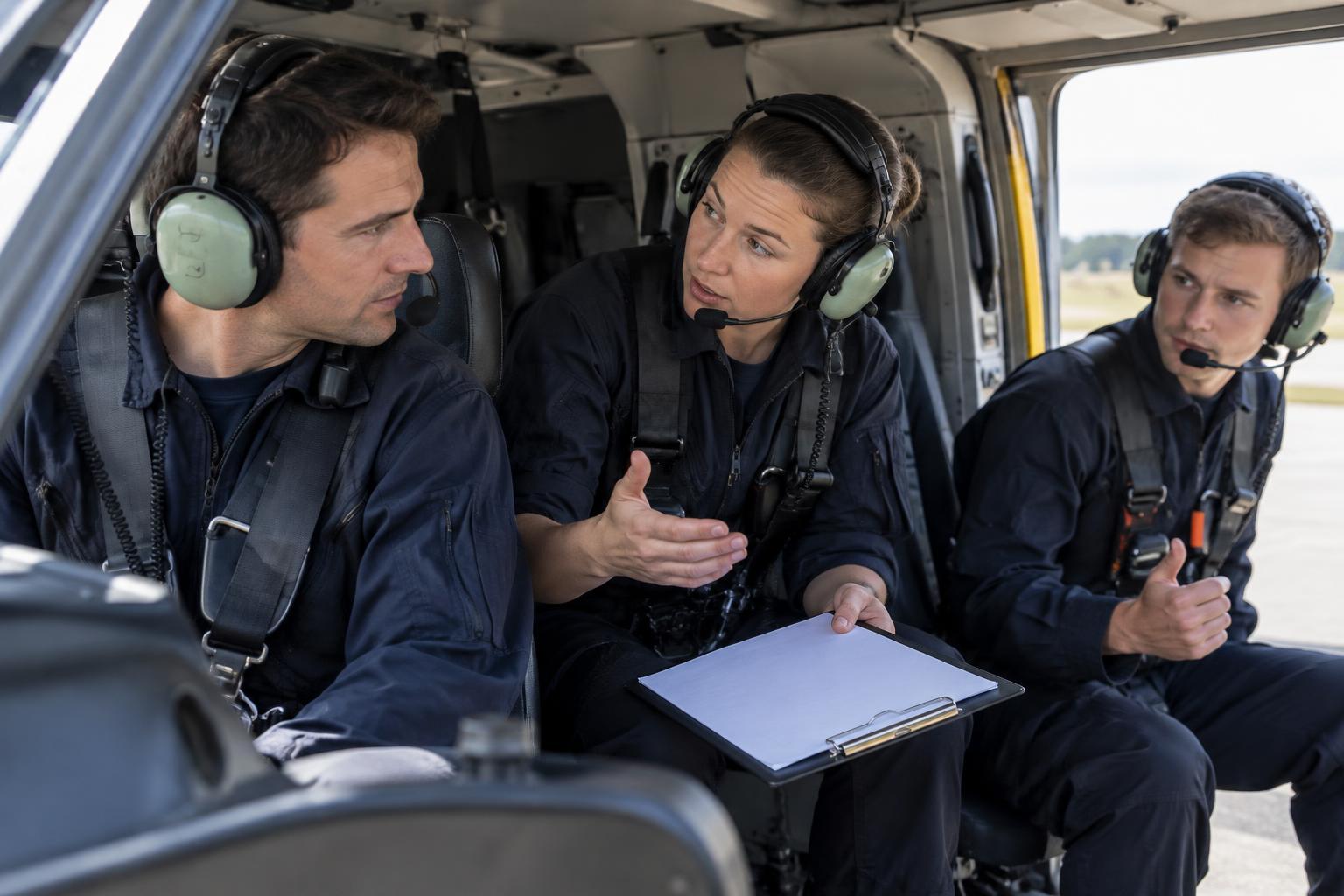
Why a message can be heard but not understood
In rescue aviation, pilots, medical personnel, dispatchers and ground teams may all contribute information to a transport. Each role sees a different part of the situation. A message can reach its intended listener and still fail to create a shared understanding: a location may be heard without a clear reference point, or a change in plans may be acknowledged without everyone knowing what happens next.
Teams can identify this kind of gap by paying attention to what people do after a message. If two people act on different assumptions, ask the same question later, or describe the plan differently, the original exchange may not have been specific enough. Clarifying the information is more useful than deciding who should have understood it the first time.
Vague requests and missing confirmation
A common mistake is to make a request without naming the person responsible or the result needed. “Can someone check that?” may sound efficient, but several people might assume someone else is handling it. Ambiguous terms such as “soon” or “over there” can cause similar trouble when a crew is working across an aircraft, landing area and communications channel.
One way teams spot the problem is by checking whether a request has a clear owner and whether its completion is visible to the people who need to know. A brief reply that repeats the essential detail can reveal a mismatch before it spreads. Confirmation does not need to turn every conversation into a script; it is most valuable when a detail affects coordination or could be easily misunderstood.
Assumptions during handoffs
Handoffs are vulnerable because the person giving an update already knows the background, while the receiver may not. A speaker might mention a decision but omit why it changed, or assume that a dispatcher, incoming crew member or ground contact has seen the same information. Even accurate facts can be hard to use if their status is unclear: is a destination confirmed, proposed or still being checked?
Teams can identify incomplete handoffs by inviting the receiver to state their understanding of the current plan, unresolved questions and next contact. Questions such as “What is still uncertain?” make missing context easier to find without requiring anyone to admit confusion. When information changes, clearly separating the old plan from the new one helps prevent both from remaining in circulation.
Information lost in noise, workload or hierarchy
Aircraft noise, radio traffic and busy phases of a mission can compete for attention. A message delivered at the wrong moment may receive a quick acknowledgment but little processing. Another obstacle is social rather than technical: a team member may notice a discrepancy yet hesitate to interrupt someone more experienced or already occupied.
Signs include repeated calls, delayed answers, conflicting accounts of what was said, or an important concern raised only after the task is over. Teams can make those patterns easier to catch by treating requests for repetition and clarification as normal. Stating a concern plainly, then checking that it was heard, gives colleagues a chance to examine it. The aim is not constant interruption; it is to make relevant information available when the team needs it.
Learning from small mismatches
Not every communication mistake produces a visible problem. A crew may resolve an unclear instruction immediately, or a ground contact may ask a question that exposes a missing detail. These small recoveries are useful evidence. They show where wording, timing or assumptions made coordination harder than it needed to be.
After an activity, a short review can focus on what each person understood at key moments, how a mismatch was noticed and what helped resolve it. This is more informative than simply labeling a message “good” or “bad.” Different operators use different procedures, but the general lesson is consistent: effective crew communication depends not only on sending information, but on checking that the right people can use it.